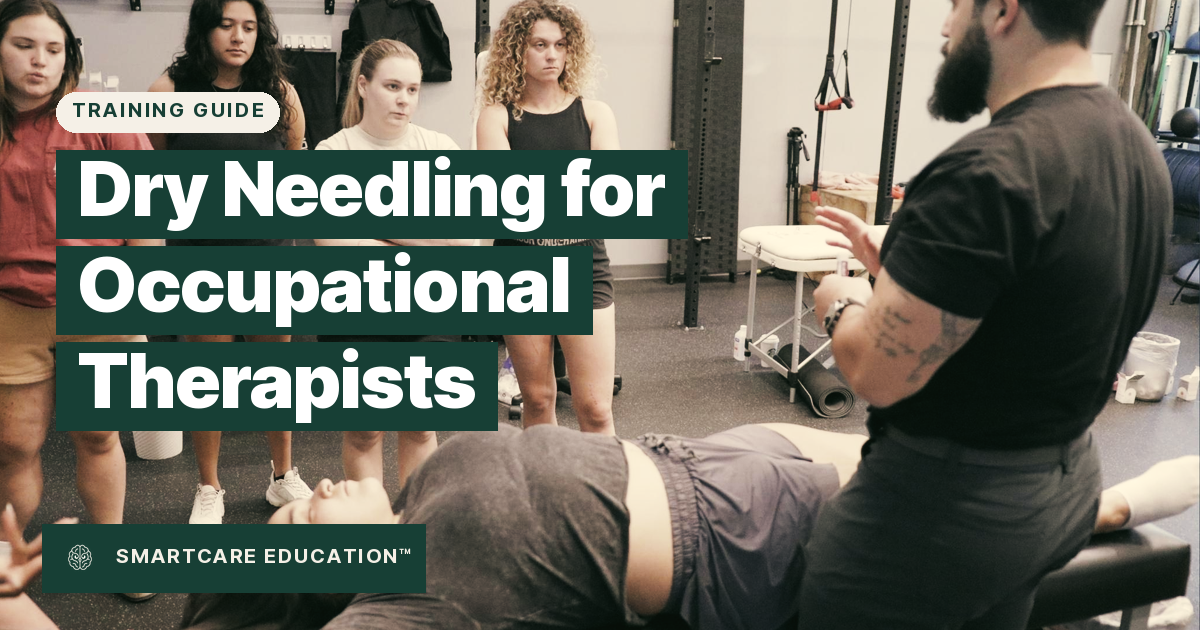
Dry needling for occupational therapists: training, scope, and certification (2027 guide)
Yes, occupational therapists can perform dry needling in a growing number of states. Authorization is not universal. It depends on your state's practice act, any relevant board opinions or rulings, and whether you have completed appropriate training. The regulatory landscape has been evolving steadily in favor of OT dry needling, but it remains inconsistent across states. The first step for any OT considering this is a direct inquiry to your state licensing board.
This guide covers what occupational therapists in the United States need to know about dry needling: whether it falls within your scope of practice, what training is typically required, how OT dry needling compares to PT and chiropractic authorization, how to evaluate certification programs, and how to integrate dry needling into OT clinical practice. If you are a licensed OT who wants to add dry needling to your skill set, this is where to start.
Can occupational therapists perform dry needling?
The short answer is yes, in many states, but not uniformly. Dry needling authorization for occupational therapists is determined at the state level and varies considerably. Some states have explicitly authorized OT dry needling through board opinions, advisory letters, or statutory language. Others have not addressed it directly, leaving practitioners in a gray zone. A smaller number have taken positions that restrict or prohibit OTs from performing the technique.
This is different from the situation for physical therapists, who have secured explicit authorization in a larger number of states. It is also different from chiropractic, where authority to use soft tissue techniques including dry needling is more broadly established. OT is catching up, and the trend line is moving in the right direction, but the current state-by-state picture requires that you do your own verification before practicing. See our dry needling laws by state guide for a state-level overview.
AOTA's position on dry needling
The American Occupational Therapy Association has generally taken a supportive position on dry needling as a technique that can fall within OT scope of practice when the therapist holds proper training and when state law permits it. Scope of practice is defined by each state's practice act, board regulations, and any applicable court or administrative rulings. AOTA's support provides professional backing, not legal authorization. The two things are not the same.
The trend toward explicit authorization
Over the past several years, a meaningful number of state OT boards have issued opinions or adopted positions that permit dry needling, particularly for OTs with advanced training in musculoskeletal and orthopedic settings. This mirrors the trajectory PTs followed a decade earlier. If your state has not yet issued formal guidance, that does not automatically mean the answer is no. It may mean a formal scope inquiry to your board is the appropriate next step.
Why occupational therapists are adding dry needling
Dry needling is a natural fit for many areas of OT practice, particularly in orthopedic and hand therapy settings. If you are treating patients for upper extremity conditions, chronic musculoskeletal pain, or return-to-work rehabilitation, you are already working in the precise patient populations where myofascial trigger points are most clinically relevant.
Forearm extensor and flexor trigger points are among the most commonly implicated sources of referred pain in lateral and medial epicondylitis. Thenar and hypothenar muscle tension contributes to hand and wrist dysfunction that OTs treat every day. Rotator cuff trigger points drive referred pain and movement restriction in patients recovering from shoulder surgery, workplace injuries, and chronic overhead use. These are not edge cases. They are the core of what many OTs see in practice. Learn more about what dry needling is and how it works.
Patient populations that benefit
The patient populations most likely to benefit from OT-administered dry needling include:
- Hand therapy patients with forearm, wrist, and intrinsic muscle involvement
- Upper extremity post-surgical rehabilitation
- Work-related musculoskeletal injuries with chronic pain components
- Neurological rehabilitation patients with spasticity or muscle overuse patterns
- Chronic pain patients whose functional limitations are driven in part by trigger point activity
How dry needling complements OT's existing framework
OT practice is built around function. The goal is not just pain reduction; it is restoring the patient's ability to perform meaningful activities. Dry needling fits this framework well when used as a precursor to therapeutic activity. Reducing trigger point activity before a hand therapy session or work-hardening exercise can produce better movement quality, greater range of motion, and higher patient tolerance for functional loading. The needle is a preparation tool, not an end point. That framing aligns naturally with how OTs already think about treatment sequencing.
Growing patient demand for non-pharmacological pain management has also made dry needling a competitive differentiator for OT practices and clinics looking to expand their service offerings.
OT dry needling scope compared to PT and chiropractic
Understanding how OT dry needling authorization compares to PT and DC authorization helps clarify where things stand professionally and regulatorily.
Physical therapists have the broadest legislative track record on dry needling. Most states that have addressed the question have authorized it for PTs, typically under their existing authority to perform therapeutic procedures for musculoskeletal dysfunction. See our guide on dry needling training for physical therapists for comparison.
Chiropractors have established authority to perform soft tissue procedures in most states, and dry needling has been incorporated into that authority either explicitly or through board opinions in a significant number of jurisdictions. See our guide on dry needling for chiropractors.
Occupational therapists face a more varied picture, but the underlying clinical argument is strong, particularly in orthopedic and hand therapy subspecialties. OT's activity-based, function-focused scope provides a coherent rationale for dry needling as a preparatory intervention for therapeutic occupation.
Key regulatory differences
The mechanism by which dry needling is authorized differs by profession. For PTs and DCs, authorization often flows from existing statutory language about therapeutic procedures, modalities, or manual therapy. For OTs, the pathway frequently requires a formal scope-of-practice opinion from the state board because OT practice acts were not written with dry needling explicitly in mind.
The legal distinction between dry needling and acupuncture is also relevant here. Regardless of profession, dry needling is consistently distinguished from acupuncture on the basis of theoretical framework and training, not the needle itself. See our full breakdown of dry needling versus acupuncture.
Training requirements for OT dry needling
Training requirements vary by state, but most jurisdictions that authorize OT dry needling expect practitioners to complete a structured program that includes both didactic content and supervised hands-on practice before performing the technique on patients.
Didactic components
A complete dry needling training program for OTs should cover:
- Functional anatomy relevant to needling target sites, with particular depth in the upper extremity given OT's clinical focus
- Myofascial trigger point theory: formation, referral patterns, clinical presentation
- Needling technique: needle selection, insertion depth, angle, tissue feel, local twitch response
- Safety and contraindications: pneumothorax risk, vascular structures, patient populations requiring modified approach
- Infection control and clean needle technique
- Documentation standards and informed consent
- Adverse event management
Hands-on components
Competency in dry needling cannot be developed through coursework alone. Supervised practice on live subjects is necessary to develop the tactile skills required for safe, effective needling.
OT-specific clinical integration
One limitation of many generic dry needling courses is that they are not designed with OT clinical integration in mind. As an OT, you will need to think through how needling fits into your specific treatment context: how it sequences with purposeful activity, how you document it within an OT plan of care, and how to communicate it to patients.
Choosing a dry needling certification program as an OT
The dry needling education market has grown significantly in recent years. Not all programs are equal in quality, comprehensiveness, or rigor.
What to look for
An evidence-based curriculum is non-negotiable. The program should be grounded in peer-reviewed research on trigger point science, needling technique, and clinical outcomes. Instructors should have documented clinical experience with dry needling, not just teaching credentials.
Format considerations
Online, in-person, and hybrid formats each have tradeoffs. See our comparison of online dry needling certification and in-person dry needling training. See our full overview of what to look for in a dry needling certification program.
SmartCARE Education™'s CDNP program
SmartCARE Education™'s Certified Dry Needling Practitioner (CDNP) program is the most comprehensive online dry needling certification currently available. It covers full-body trigger point anatomy and needling technique through a self-paced, online format designed for working clinicians.
One important clarification for occupational therapists: the CDNP is PACE approved for chiropractic continuing education only. SmartCARE Education™ makes no representation that its courses fulfill OT CE requirements in any state. If you are an OT considering the CDNP, contact your state OT licensing board to determine whether the program qualifies for CE credit under your jurisdiction's rules.
What the CDNP does provide is a rigorous foundational curriculum in dry needling science and technique that prepares clinicians to practice competently and safely. Learn more about the CDNP program.
Clinical integration for OT practice
Adding dry needling to your OT practice requires more than completing a certification course. It requires a clear framework for how needling fits into your plan of care.
Upper extremity focus
For most OTs, the upper extremity is where dry needling will see the heaviest use. Key target areas include:
- Forearm extensor group: relevant in lateral epicondylitis, wrist extensor tendinopathy, and radial tunnel syndrome
- Forearm flexor group: relevant in medial epicondylitis, carpal tunnel syndrome, and grip dysfunction
- Thenar and hypothenar muscles: relevant in thumb CMC arthritis, de Quervain tenosynovitis, and intrinsic tightness
- Rotator cuff: central to shoulder dysfunction in post-surgical and chronic pain populations
- Cervical and periscapular musculature: relevant in thoracic outlet syndrome and referred upper extremity pain
Treatment sequencing
The most effective sequencing places dry needling before therapeutic activity, not after. Reducing trigger point activity first allows the patient to perform subsequent exercise and functional tasks with greater range, less guarding, and more motor recruitment quality. See the research on whether dry needling works.
Documentation requirements
Documentation for dry needling within an OT plan of care should include: clinical rationale linking trigger point findings to the patient's functional limitations, the specific muscles treated and technique used, the patient's response, and the functional outcome measure being tracked.
Malpractice and liability considerations
Before performing dry needling, verify that your professional liability insurance policy covers the technique. Do not assume coverage exists. Request written confirmation from your carrier.
Billing dry needling as an OT
The billing mechanics for dry needling are the same regardless of whether the practitioner is an OT, PT, or DC. The current CPT codes are:
- CPT 20560: Needle insertion without injection, 1 or 2 muscle(s)
- CPT 20561: Needle insertion without injection, 3 or more muscle(s)
These codes apply to any qualified provider performing the service. Payer coverage remains variable. See our detailed guide on dry needling CPT codes and billing.
Frequently asked questions
Can OTs do dry needling?
Yes, in a growing number of states. Authorization varies by state. Before practicing, verify the current status with your state OT licensing board.
What training do occupational therapists need for dry needling?
State requirements vary, but most expect completion of a structured training program covering anatomy, trigger point theory, needling technique, safety, and supervised hands-on practice.
Is dry needling within OT scope of practice?
AOTA has generally supported dry needling within OT scope when the therapist is trained and state law permits it. Your state practice act and board opinions govern.
How is dry needling different from acupuncture for OTs?
Dry needling is based on Western musculoskeletal anatomy and trigger point science. Acupuncture is based on TCM meridian theory. They are regulated separately. See our full comparison.
Can OTs bill for dry needling?
Yes. CPT codes 20560 and 20561 apply to all qualified providers, including OTs. Payer coverage varies. See our CPT codes guide.
What is the best dry needling course for occupational therapists?
SmartCARE Education™'s CDNP is the most comprehensive online dry needling certification available. The CDNP is PACE approved for chiropractic CE only. OTs should verify CE applicability with their state board. Learn more about the CDNP.
Getting started: next steps for OTs considering dry needling
First, verify regulatory status with your state OT licensing board. Second, verify liability insurance coverage. Third, select a rigorous training program. Fourth, develop your clinical integration framework before you begin.
SmartCARE Education™'s CDNP program provides the most comprehensive online foundation available for any clinician building dry needling competency. Explore the CDNP program.
Recommended SmartCARE Education™ courses
- Online Certified Dry Needling Professional — complete the didactic portion on your schedule.
- In-person Certified Dry Needling Practitioner — hands-on training at the table.
Confirm CE acceptance with your licensing board before you enroll. PACE approval applies to chiropractors.
About SmartCARE Education™
SmartCARE Education™ is the leading provider of dry needling certification for healthcare professionals in the United States. Founded by Dr. Thomas Kauffman, DC, a practicing clinician who integrates dry needling daily in a high-volume sports medicine practice, SmartCARE offers the only comprehensive online dry needling certification (CDNP) available. The program is PACE approved for chiropractic continuing education and serves chiropractors, physical therapists, and occupational therapists nationwide. Explore the CDNP program.
