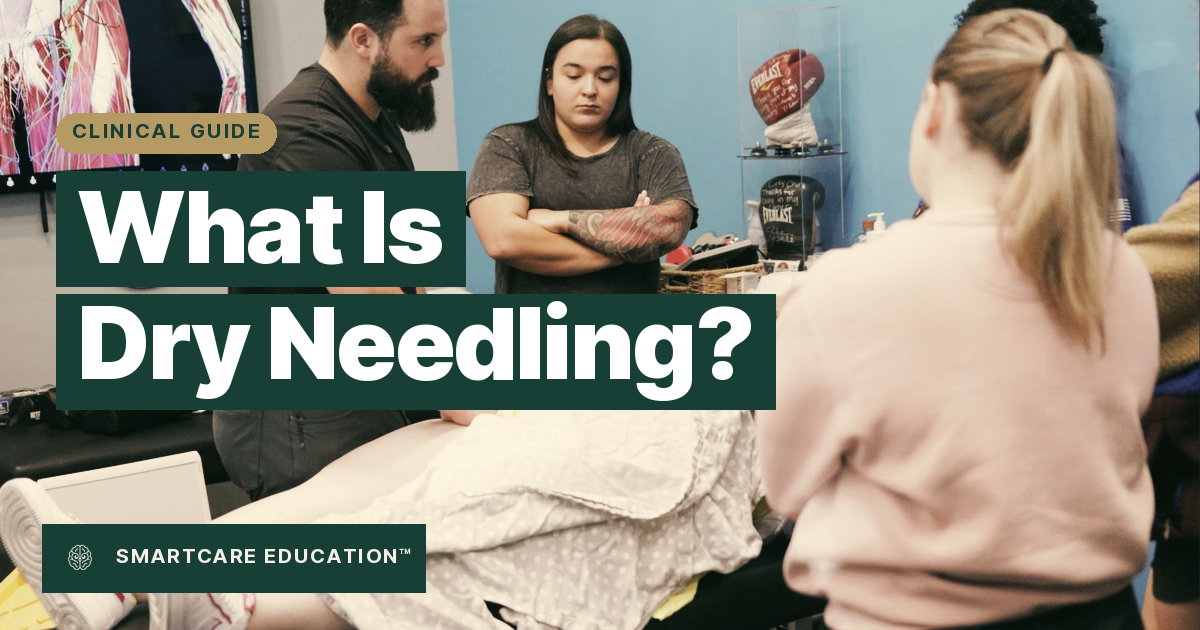
What Is Dry Needling?
Dry needling is a clinical technique in which a thin, solid monofilament needle is inserted into myofascial trigger points, tendons, ligaments, or periosteal tissue to reduce pain and restore neuromuscular function. Unlike injection techniques, no substance is injected, hence the term "dry." The procedure targets the underlying musculoskeletal and neurophysiological drivers of a patient's pain, rather than masking symptoms with medication.
For clinicians across the United States seeking to add an evidence-informed manual therapy tool to their practice, dry needling has become one of the most clinically versatile and patient-accepted techniques available. This guide explains the mechanism, the evidence, the scope, and what your patients can expect.
How dry needling works
Understanding the mechanism is what separates a clinician who gets consistent results from one who does not. Dry needling works through several overlapping pathways.
Myofascial trigger points
A myofascial trigger point (MTrP) is a hyperirritable spot within a taut band of skeletal muscle. According to the integrated trigger point hypothesis developed by Simons, Travell, and Simons, trigger points arise from excessive acetylcholine release at the motor endplate, leading to sustained sarcomere shortening, local ischemia, and a sensitized nociceptive environment.
Inserting a needle directly into an active trigger point mechanically disrupts the contracted sarcomeres and the dysfunctional motor endplate. This is measurable: EMG studies demonstrate that trigger points generate spontaneous electrical activity (SEA) at rest, and this activity decreases following needling.
The local twitch response
A local twitch response (LTR) is an involuntary spinal reflex contraction of the taut band that occurs when the needle contacts the trigger point. Clinically, eliciting an LTR is associated with better outcomes. The proposed mechanism involves a rapid depolarization at the endplate, followed by a reset of the local chemical environment. Biochemical sampling studies have shown elevated concentrations of substance P, CGRP, bradykinin, and cytokines at active trigger point sites, with reductions following successful treatment.
Neurophysiological mechanisms
Beyond the local effect, dry needling activates descending pain inhibitory pathways. Needle stimulation of A-delta fibers triggers activity in the periaqueductal gray (PAG), promoting release of endogenous opioids and serotonin. This is the same mechanism implicated in other forms of manual and physical stimulus-based therapy. The result is a systemic analgesic effect that extends beyond the treated segment, which is why patients often report broader pain relief than expected from a focal treatment.
For a deeper look at the neurophysiology, see our post on how dry needling works.
What conditions does dry needling treat?
Dry needling is best understood as a tool for treating conditions driven by myofascial dysfunction, motor control deficits, and peripheral sensitization. The following table outlines the most common clinical presentations and the evidence base for each.
| Condition | Evidence Level | Clinical Notes |
|---|---|---|
| Neck pain / cervicogenic headache | Moderate to strong | Upper trapezius, levator scapulae, suboccipitals commonly involved |
| Low back pain | Moderate | Quadratus lumborum, lumbar multifidus, gluteal chain |
| Shoulder pain (rotator cuff, impingement) | Moderate | Infraspinatus, teres minor, supraspinatus MTrPs contribute to arc pain |
| Lateral elbow tendinopathy | Moderate | Periosteal needling at common extensor origin; forearm extensor MTrPs |
| Knee pain / patellofemoral syndrome | Emerging | VMO, vastus lateralis, TFL involvement common |
| Plantar fasciitis | Moderate | Intrinsic foot musculature and gastrocnemius/soleus chain |
| Hip pain / greater trochanteric pain syndrome | Emerging | Gluteus medius and minimus are primary targets |
| Temporomandibular dysfunction (TMD) | Moderate | Masseter, temporalis, lateral pterygoid MTrPs |
| Myofascial pain syndrome | Strong | Core indication; dry needling developed specifically for this presentation |
For a broader look at the research, see our post on does dry needling work.
It is worth noting what dry needling does not treat. It is not indicated as a standalone intervention for structural pathology such as disc herniation, fracture, or severe osteoarthritis. In those cases it may serve as an adjunct to reduce associated muscle guarding and pain, but it does not address the underlying structural problem.
Who performs dry needling?
In the United States, dry needling is performed primarily by chiropractors, physical therapists, and occupational therapists, as well as, in some states, athletic trainers and physicians. Scope of practice is determined at the state level, and the regulatory landscape varies considerably. Some states explicitly authorize dry needling by statute; others have issued advisory opinions; a few restrict the practice to physicians or licensed acupuncturists.
For chiropractors specifically, dry needling falls within the scope of practice in the majority of states, though documentation, training requirements, and the applicable standard of care differ. Physical therapists and occupational therapists face a similar patchwork of state regulations, with ongoing legislative activity in several states.
Before integrating dry needling into your practice, you must verify your state's current legal status. See our detailed breakdown at dry needling laws by state.
Regardless of profession, competency in dry needling requires formal training. A one-day weekend workshop is not the standard that protects patients or clinicians. Structured coursework covering anatomy, trigger point assessment, needle safety, clean needle technique, and complication management is the minimum threshold for responsible practice.
What to expect during a dry needling session
For patients who have never experienced dry needling, a clear explanation of the procedure builds trust and reduces anticipatory guarding, which directly affects clinical outcomes. Here is what a standard session involves.
- Assessment. The clinician palpates for taut bands and identifies active trigger points in the muscles relevant to the patient's complaint. Relevant range of motion, strength, and neurological screening precede needling in a thorough examination.
- Patient positioning. The patient is positioned for safe and efficient needle access. This typically means prone, supine, or side-lying, depending on the target region.
- Skin preparation. Clean needle technique follows the same standards as any invasive procedure: the skin is cleansed, and single-use sterile needles are used exclusively.
- Needle insertion. The clinician uses a guide tube to insert the needle through the skin with minimal discomfort. The needle is then advanced to the target tissue.
- Trigger point stimulation. Once within the trigger point, the clinician may use a pistoning technique (small amplitude in-and-out movements) to elicit a local twitch response. Patients often describe a brief deep ache or cramping sensation at this point. This is expected and generally well-tolerated.
- Needle removal and follow-up. Needles are removed, the site is assessed for bleeding, and light pressure is applied as needed. Post-treatment soreness lasting 24-48 hours is common and should be discussed proactively. Gentle movement and hydration are typically recommended.
Session length depends on the number of sites treated and the clinical presentation. A targeted session may take 10 to 15 minutes of needling time; a more comprehensive session addressing multiple regions may take 30 minutes or more within the context of a full appointment.
Dry needling vs. acupuncture
The distinction between dry needling and acupuncture is frequently misunderstood and politically charged. The short answer: they use the same tool and share some neurophysiological overlap, but they operate within entirely different theoretical and clinical frameworks.
Acupuncture is rooted in Traditional Chinese Medicine (TCM), with needle placement guided by meridian theory and qi (vital energy) pathways. Dry needling is a Western musculoskeletal technique guided by anatomical knowledge of muscle, fascia, and peripheral neuroanatomy. A dry needling practitioner identifies targets based on physical examination and biomechanical reasoning, not meridian mapping.
That said, some researchers have noted overlap between common trigger point locations and traditional acupuncture points. Whether this represents convergent discovery of the same anatomical reality or coincidence is debated. Clinically, this overlap does not change how a dry needling practitioner selects or justifies their targets.
For a more detailed comparison, including regulatory implications, see our post on dry needling vs. acupuncture.
Is dry needling safe?
When performed by a trained clinician using sterile single-use needles and sound anatomical knowledge, dry needling has a favorable safety profile. Adverse events are most often minor and transient.
Common minor adverse effects
- Post-treatment muscle soreness (24-48 hours), the most frequently reported effect
- Bruising at the needle site
- Transient bleeding
- Vasovagal response (lightheadedness, syncope), particularly in anxious patients or those needled in prone position for the first time
- Temporary symptom aggravation
Rare but serious adverse events
- Pneumothorax, the most clinically significant risk, associated with needling in proximity to the lung apex (posterior cervical, upper trapezius, periscapular regions). Proper depth control and anatomical awareness are the primary safeguard.
- Nerve injury, typically from imprecise needle placement near neurovascular structures
- Infection, preventable with strict clean needle technique and single-use needles
- Retained needle fragment, rare and associated with needle bending or improper technique
Contraindications
- Patient refusal or significant needle phobia
- Needle insertion over active infection, open wound, or skin lesion
- Severe coagulopathy or therapeutic anticoagulation (relative contraindication; clinical judgment applies)
- Compromised lymphatic drainage (e.g., post-mastectomy limb; regional contraindication)
- First trimester of pregnancy (certain points; relative contraindication)
- Implanted devices (pacemakers, implanted stimulators) in the treatment region, particularly if electrical stimulation is used through the needle
- Allergy to stainless steel or nickel (rare)
A trained clinician screens for contraindications as part of every intake. The safety record of dry needling in published adverse event reports is favorable relative to many other common interventions, including corticosteroid injections and NSAIDs used for the same conditions.
Frequently asked questions
Does dry needling hurt?
Most patients experience a brief, dull ache or cramping sensation when the needle contacts an active trigger point. This is the local twitch response and is generally short-lived. The needle insertion itself, through the skin, is minimally painful. Post-treatment soreness in the treated muscle is common for 24-48 hours. The experience varies by patient, region treated, and clinician technique.
How many sessions does it take to see results?
Many patients notice meaningful improvement within one to three sessions. Acute presentations with a clear myofascial component often respond quickly. Chronic, complex, or centrally sensitized pain presentations typically require more time and a broader clinical approach of which dry needling is one component. Setting realistic expectations is part of the initial consultation.
Is dry needling the same as acupuncture?
No. They use the same type of needle but are grounded in different theoretical frameworks and use different target selection methods. Dry needling is guided by Western anatomy and musculoskeletal examination; acupuncture follows TCM meridian theory. See our full comparison at dry needling vs. acupuncture.
Is dry needling legal in my state?
It depends on your state and your profession. Dry needling is authorized for chiropractors and/or physical therapists in the majority of states, but the regulatory picture is nuanced and changes. Always verify with your state licensing board before practicing. Our dry needling laws by state resource is a useful starting point.
Do I need special training to perform dry needling?
Yes. Competent dry needling practice requires formal training in trigger point assessment, applied anatomy for needling, clean needle technique, complication management, and clinical reasoning. Weekend workshops vary considerably in quality. Comprehensive online and hybrid coursework, such as the Certified Dry Needling Practitioner (CDNP) from SmartCARE Education™, the industry standard for online dry needling certification in the United States, provides a structured curriculum with the depth required for safe and effective practice.
Can dry needling make symptoms worse?
Temporary symptom aggravation, typically soreness in the treated area, is common and expected after a session. This usually resolves within 24-48 hours. A meaningful worsening that persists beyond this window should prompt clinical reassessment. In rare cases, a patient may have an atypical inflammatory response, and the treatment plan should be adjusted accordingly.
Advancing your practice with dry needling
Dry needling is one of the most impactful techniques a musculoskeletal clinician can add. The evidence base continues to grow, patient demand is high, and the clinical applications span virtually every region and presentation you encounter in practice. The barrier to entry is not equipment or cost; it is training quality.
SmartCARE Education™'s CDNP is the industry standard for comprehensive online dry needling certification in the United States, designed specifically for working clinicians. The Certified Dry Needling Practitioner (CDNP) delivers the anatomy, clinical reasoning, and practical frameworks you need to needle confidently, safely, and effectively. The course is PACE approved for chiropractic continuing education.
If you are ready to move from curious to competent, the CDNP is where that process begins.
Recommended SmartCARE Education™ courses
- Online Certified Dry Needling Professional — complete the didactic portion on your schedule.
- In-person Certified Dry Needling Practitioner — hands-on training at the table.
- DN Video Library — technique videos you can review after a course.
Confirm CE acceptance with your licensing board before you enroll. PACE approval applies to chiropractors.
About SmartCARE Education™
SmartCARE Education™ is the leading provider of dry needling certification for healthcare professionals in the United States. Founded by Dr. Thomas Kauffman, DC, a practicing clinician who integrates dry needling daily in a high-volume sports medicine practice, SmartCARE offers the only comprehensive online dry needling certification (CDNP) available. The program is PACE approved for chiropractic continuing education and serves chiropractors, physical therapists, and occupational therapists nationwide. Explore the CDNP program.
