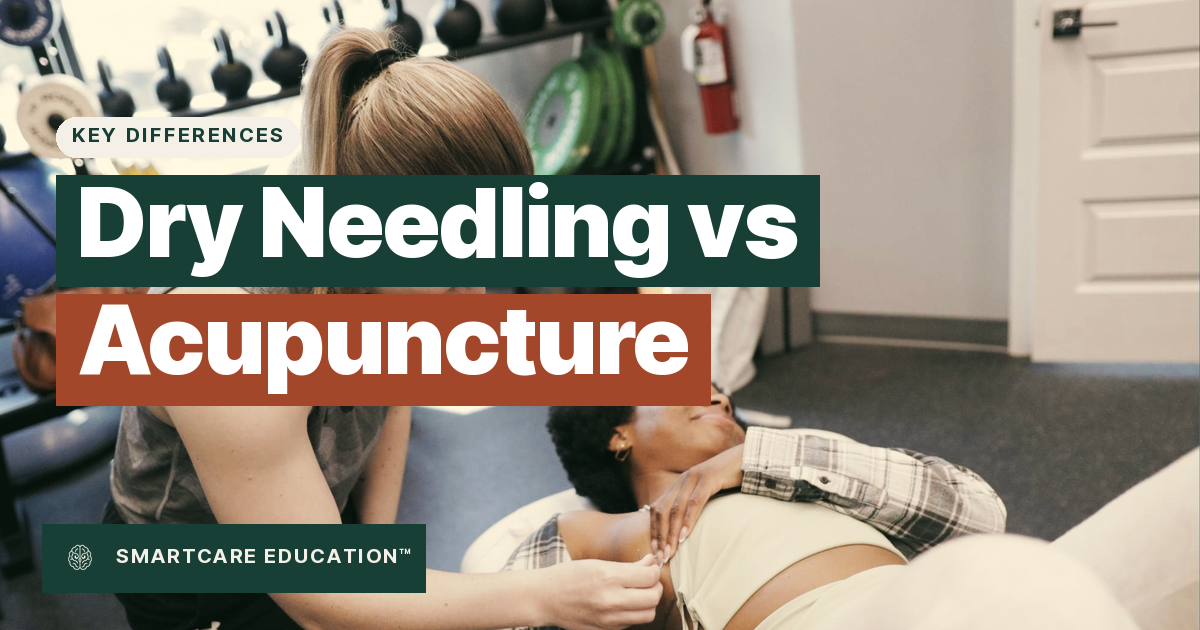
Dry needling vs acupuncture: the key differences
Dry needling and acupuncture both use thin, solid-filament needles inserted into the body, but they differ fundamentally in theoretical framework, training pathway, clinical intent, and the conditions they are designed to treat. Dry needling is a Western, neuroanatomy-based intervention targeting myofascial trigger points and peripheral pain mechanisms; acupuncture is rooted in Traditional Chinese Medicine and targets meridian-based energy flow. Understanding that distinction matters clinically, legally, and professionally.
For clinicians across the United States considering adding needling to their practice, the difference is not merely academic. Scope of practice laws, CE requirements, malpractice coverage, and patient communication all hinge on which approach you are practicing and under which credential. This post clarifies the key distinctions so you can make informed decisions about training, documentation, and clinical application. For a broader orientation to the intervention itself, see What Is Dry Needling.
Theoretical foundations
Dry needling: Western neuroanatomy and pain science
Dry needling emerged in the latter half of the 20th century from the work of physicians investigating myofascial pain, most notably Janet Travell and David Simons. Their research mapped reproducible patterns of referred pain originating from hyperirritable foci within skeletal muscle, which they termed myofascial trigger points. The needle is used to mechanically disrupt the trigger point, elicit a local twitch response, and initiate a cascade of neurophysiological changes.
The proposed mechanisms include normalization of end-plate noise, reduction of local inflammatory mediators such as substance P and calcitonin gene-related peptide, and modulation of central sensitization through ascending and descending pain pathways. These mechanisms are grounded in peripheral and central nervous system anatomy and are testable within the framework of contemporary pain science. For a deeper review of the physiological model, see How Does Dry Needling Work.
Critically, dry needling makes no claims about energy, vital force, or spiritual physiology. The rationale is mechanical and neurochemical, and the target is a specific anatomical structure within a specific tissue.
Acupuncture: Traditional Chinese Medicine and meridian theory
Acupuncture is one component of a comprehensive system of traditional Chinese medicine with roots extending roughly 2,000 years. The classical framework holds that vital energy, or qi, flows through a network of channels called meridians. Disruption of that flow is understood to produce illness and pain. Needle insertion at designated acupuncture points is intended to restore balanced flow and support systemic health.
Contemporary acupuncture practice spans a spectrum. This has produced ongoing debate within the acupuncture community itself about the appropriate theoretical frame.
The core distinction remains: acupuncture point selection is guided by diagnostic categories (heat, deficiency, stagnation, and so on) that do not map directly to Western anatomical diagnosis. A clinician trained in dry needling and a licensed acupuncturist may insert a needle into an adjacent location, but they arrived there by entirely different clinical reasoning.
Training and credentialing
Acupuncture licensure
In the United States, acupuncture is a licensed profession in most states. A licensed acupuncturist (LAc) typically completes a three-to-four-year master's-level program, though doctoral programs (DAOM or DAc) are increasingly common. Training includes extensive coursework in traditional Chinese medicine theory, Chinese herbal medicine, point location, and clinical internship hours that typically number in the hundreds.
The National Certification Commission for Acupuncture and Oriental Medicine (NCCAOM) offers the primary board examination pathway for licensure in most states.
Dry needling credentialing for chiropractors, physical therapists, occupational therapists, and other providers
Dry needling is not a standalone licensed profession. It is an adjunct technique performed within the scope of an existing clinical license. Chiropractors, physical therapists, occupational therapists, and some other providers may perform dry needling in states where their scope of practice explicitly permits it or where it has been interpreted as within scope.
Training programs vary significantly in length and depth, ranging from weekend seminars to structured, competency-based curricula covering anatomy, safety, indications, contraindications, and technique. There is no single national credential for dry needling across all professions, though individual certifications exist.
If you are exploring a structured, clinically rigorous pathway, the dry needling certification overview on this site covers what to look for in a qualifying program. If your schedule requires flexibility, SmartCARE Education™'s CDNP, the industry standard for comprehensive online dry needling certification in the United States, is designed for practicing clinicians and is PACE approved for chiropractic CE. Learn more at the CDNP program page.
Clinical technique comparison
Both modalities use solid-filament, sterile needles. The similarities largely end there. The table below summarizes the primary technical differences.
| Feature | Dry Needling | Acupuncture |
|---|---|---|
| Needle gauge | Typically 0.25-0.30 mm; may use longer needles for deep targets | Typically 0.16-0.30 mm; finer gauges common for superficial work |
| Insertion target | Myofascial trigger point within a specific muscle belly | Acupuncture point along a meridian pathway |
| Diagnostic basis for point selection | Palpation, referred pain patterns, Western orthopedic exam | TCM diagnosis: pulse, tongue, symptom patterns, meridian assessment |
| Needle manipulation | Often involves pistoning or sparrow-pecking technique to elicit local twitch response | Often involves rotation, lift-thrust, or retention without manipulation |
| Desired response | Local twitch response; post-needling soreness followed by tissue release | De qi sensation (heaviness, distension, warmth); varies by style |
| Needle retention | Typically brief; often removed immediately after twitch response | Typically retained 15-30 minutes |
| Number of needles per session | Typically fewer; focused on specific symptomatic regions | Variable; may include distal and systemic points unrelated to pain site |
These are generalizations. Both practices contain significant internal variation by school, style, and individual practitioner. A Japanese acupuncturist's technique looks quite different from a traditional Chinese style; trigger point dry needling looks different from the functional dry needling approach advocated by some physical therapy educators.
Conditions treated
Overlap
Both modalities are commonly used for musculoskeletal pain. Neck pain, low back pain, shoulder dysfunction, and tension-type headache appear in the clinical literature and practice patterns for both approaches. A patient presenting with chronic trapezius pain and cervicogenic headache might reasonably seek either a dry needling provider or a licensed acupuncturist and receive needle-based treatment from both.
Where they diverge
Acupuncture's scope of clinical application is considerably broader in terms of the conditions it purports to treat. Practitioners trained in TCM address digestive disorders, menstrual irregularities, anxiety, insomnia, immune support, and systemic conditions that fall well outside the myofascial pain model. Whether the evidence supports those applications varies considerably by condition.
Dry needling, by contrast, is generally applied to conditions where a myofascial component is identifiable on clinical examination. It is a targeted, site-specific intervention. A dry needling provider would not typically needle for systemic conditions using the same clinical reasoning that guides trigger point treatment.
In practice, some licensed acupuncturists are also trained in trigger point dry needling and may integrate both approaches. The reverse is less common: most chiropractors, physical therapists, and occupational therapists trained in dry needling are not trained in TCM acupuncture.
What the research says
The evidence base for both interventions is active and evolving, and neither is without methodological challenges. Designing a credible sham condition for needling trials is genuinely difficult. Retractable placebo needles, superficial needling at non-points, and needling at non-trigger-point sites have all been used as controls, each with limitations.
For dry needling, the strongest evidence supports its use in myofascial pain conditions, particularly for short-term reductions in pain intensity and improvements in pressure pain threshold.
The debate over whether effects exceed sham by a clinically meaningful margin continues.
The two bodies of literature are largely parallel rather than directly comparative. Head-to-head trials comparing dry needling and acupuncture for the same condition are sparse. For a more detailed look at the evidence underlying dry needling specifically, see Does Dry Needling Work.
Scope of practice considerations
This is where the practical stakes are highest for non-acupuncturist clinicians. Dry needling sits in a complicated regulatory space in the United States. State laws vary significantly: some states explicitly authorize chiropractors, physical therapists, or occupational therapists to perform dry needling; others prohibit it or have not addressed it through statute or board ruling.
In some states, acupuncture boards have argued that dry needling constitutes the practice of acupuncture and therefore requires an acupuncture license. Other state chiropractic and physical therapy boards have affirmed that dry needling falls within their professions' existing scopes. The legal landscape shifts periodically as boards issue opinions and legislatures pass new statutes.
Before adding dry needling to your practice, you must verify your state's current position, your malpractice carrier's requirements regarding training hours and documentation, and your employer's credentialing standards if applicable. A state-by-state reference is available at Dry Needling Laws by State.
Practicing acupuncture without a license is a different and more serious legal matter. Clinicians performing dry needling should be able to clearly articulate that their practice is grounded in Western anatomical principles, documented with a musculoskeletal diagnosis, and consistent with their licensure, not with TCM diagnosis or meridian theory.
Frequently asked questions
Is dry needling just acupuncture with a different name?
No. The techniques share the same tool, a thin solid-filament needle, but differ in theoretical basis, diagnostic reasoning, point selection, needle technique, and training pathway. Dry needling is grounded in Western neuroanatomy and targets myofascial trigger points. Acupuncture is grounded in Traditional Chinese Medicine and targets points along meridian pathways. Calling dry needling a form of acupuncture is contested by the practitioners of both disciplines and has significant regulatory implications depending on your state.
Can a chiropractor or physical therapist legally perform dry needling?
It depends on your state. Some states explicitly permit it; others prohibit it or have no clear ruling. You must verify your state board's current position before practicing. See Dry Needling Laws by State for a state-by-state reference.
Can I be trained in both dry needling and acupuncture?
Yes. Some clinicians hold both a chiropractic or physical therapy license and a separate acupuncture license, having completed a full acupuncture training program. Others learn dry needling as a musculoskeletal technique within their existing scope. The two are not mutually exclusive, but they represent very different training commitments. A weekend dry needling course does not constitute acupuncture training, and a full acupuncture licensure program far exceeds what is required to competently practice trigger point dry needling.
Do patients prefer one over the other?
Patient preference varies and is often shaped by prior experience, cultural background, and the framing they receive from their provider. Some patients respond well to a biomedical explanation of trigger points and neuromuscular physiology; others are drawn to a more holistic or energetic framework. Neither preference is a reliable predictor of clinical outcome. What matters most to patient satisfaction is typically the provider's confidence, communication, and the results they produce.
Which has better evidence?
Both have supporting evidence, and both face methodological criticism. Acupuncture has a larger and more mature body of randomized controlled trials, partly because the intervention has been practiced and studied for longer. Dry needling has a growing evidence base, particularly for musculoskeletal pain. Neither is definitively superior in the research literature when the full range of conditions is considered, and direct comparison trials are limited. For a focused review of dry needling evidence, see Does Dry Needling Work.
Will my malpractice insurance cover dry needling?
Most major chiropractic and physical therapy malpractice carriers offer coverage for dry needling, often with specific training hour requirements (commonly 24 to 54 hours) Confirm coverage and any hour thresholds with your malpractice carrier.. You should confirm coverage explicitly with your carrier before adding dry needling to your services, and document your training credentials in your credentialing file.
Understanding the distinction between dry needling and acupuncture is foundational for any clinician who wants to practice needle-based techniques responsibly. The two approaches share an instrument but diverge in theory, training, regulatory standing, and clinical application. If you are a chiropractor looking to add dry needling within your existing scope, SmartCARE Education™'s CDNP, the most comprehensive online dry needling certification in the United States, offers a rigorous, PACE-approved pathway you can complete without leaving your practice. Learn more at the CDNP program page.
Recommended SmartCARE Education™ courses
- Online Certified Dry Needling Professional — complete the didactic portion on your schedule.
- In-person Certified Dry Needling Practitioner — hands-on training at the table.
Confirm CE acceptance with your licensing board before you enroll. PACE approval applies to chiropractors.
About SmartCARE Education™
SmartCARE Education™ is the leading provider of dry needling certification for healthcare professionals in the United States. Founded by Dr. Thomas Kauffman, DC, a practicing clinician who integrates dry needling daily in a high-volume sports medicine practice, SmartCARE offers the only comprehensive online dry needling certification (CDNP) available. The program is PACE approved for chiropractic continuing education and serves chiropractors, physical therapists, and occupational therapists nationwide. Explore the CDNP program.
