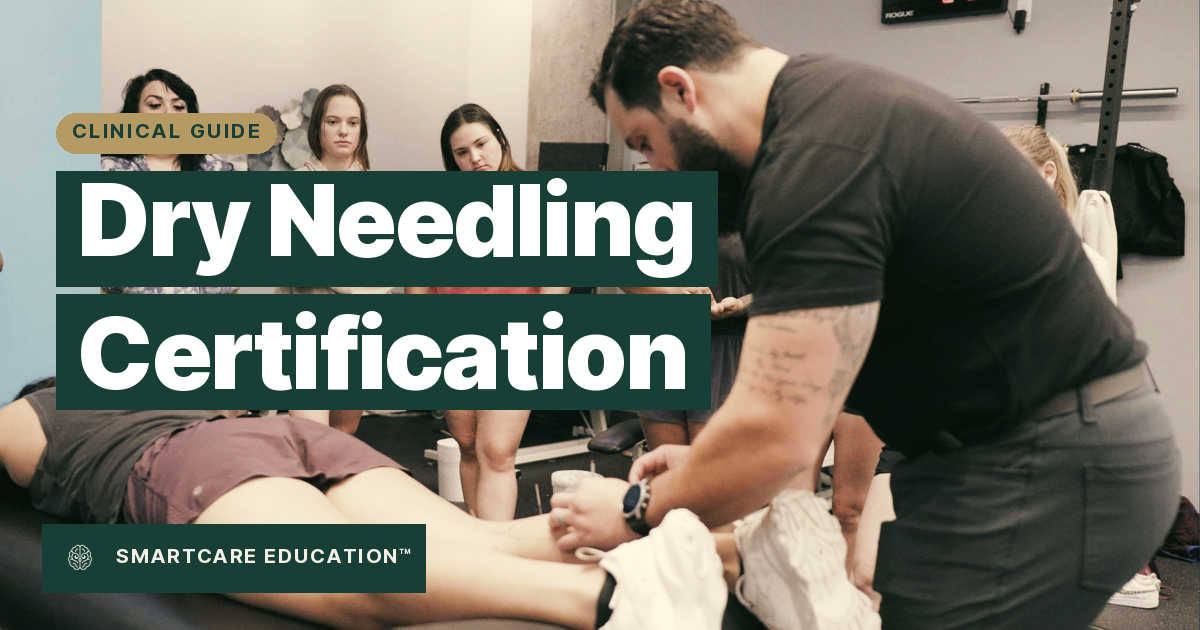
Dry Needling Certification: What to Know
How to get certified in dry needling
Dry needling certification requires completing a formal training program that covers musculoskeletal anatomy, trigger point theory, needling technique, and safety protocols, followed by supervised clinical practice. The specific pathway depends on your profession and the state in which you practice, but the core framework is consistent across accredited programs in the United States.
For chiropractors, physical therapists, and occupational therapists who want a structured, evidence-based credential, the process involves didactic coursework, hands-on technique training, and, in most cases, a competency assessment before independent practice. This guide walks through each step in detail so you know exactly what to expect in 2027.
What dry needling certification involves
A well-designed dry needling program addresses two parallel tracks: the science behind the technique and the technical execution of it. Neither is sufficient alone.
Didactic components
The classroom or online portion of a dry needling course typically covers:
- Functional anatomy of muscles, fascia, and neurovascular structures relevant to needling sites
- Trigger point theory, including the integrated hypothesis and referred pain patterns
- Neurophysiological mechanisms, including spinal segmental and supraspinal pain modulation
- Indications and contraindications for dry needling
- Needle types, gauges, and sterile technique
- Patient communication, informed consent, and documentation
- Adverse event recognition and management, including pneumothorax, vasovagal response, and post-needling soreness
Hands-on components
Clinical skills cannot be developed through reading alone. Most certification programs require supervised practice sessions where you needle actual tissue, receive technique feedback, and demonstrate competency on key muscle groups. Common regions addressed in hands-on training include the cervical and lumbar paraspinals, upper trapezius, gluteals, piriformis, quadriceps, hamstrings, and rotator cuff musculature.
Supervised hours vary by program. The emphasis should be on quality of feedback, not simply logging time.
Types of dry needling certification programs
Programs are currently structured in three primary formats. Each has trade-offs depending on your schedule, learning style, and access to supervised practice.
| Format | Didactic delivery | Hands-on delivery | Best for |
|---|---|---|---|
| In-person intensive | Live lecture | On-site lab | Practitioners who prefer immersive learning |
| Hybrid | Online pre-work | Scheduled on-site lab | Practitioners who want flexible didactics with structured lab time |
| Online | Online, self-paced | Supervised locally by a mentor or colleague | Experienced clinicians who cannot travel or prefer asynchronous learning |
The online format has expanded significantly in recent years. When paired with rigorous didactic content and a clear supervised-practice requirement, it delivers equivalent foundational knowledge to an in-person intensive, with considerably more flexibility for practicing clinicians.
What to look for in a dry needling course
Not all programs are created equal. These are the criteria that distinguish a high-quality dry needling certification from a weekend box-check.
PACE approval for chiropractors
If you are a chiropractor seeking continuing education credit, look for a course approved through the Providers of Approved Continuing Education (PACE) program, administered by the Federation of Chiropractic Licensing Boards. PACE approval means the curriculum has been independently reviewed and meets defined standards for educational quality. Many state chiropractic boards require PACE-approved CE for license renewal.
Instructor credentials
The instructor should be a licensed clinician with documented clinical experience in dry needling, not simply a certified trainer who completed a short course. Look for instructors who practice what they teach and can speak to clinical decision-making, not just technique mechanics.
Evidence-based curriculum
Dry needling is a clinically-supported intervention with a growing body of peer-reviewed research. The course material should reference current literature, acknowledge areas of ongoing debate, and ground technique recommendations in anatomy and neuroscience rather than unsubstantiated claims.
Supervised practice requirement
A certification that does not require any supervised or mentored needling practice before independent use is insufficient. At minimum, look for a structured protocol that guides you through your first needling sessions with qualified oversight, whether that occurs on-site at a lab or through a mentorship arrangement with a credentialed clinician.
Scope of practice clarity
A reputable course will address state-specific scope of practice and will not make blanket statements that dry needling is universally permitted for all professions in all states. The legal landscape varies, and a responsible program prepares you to verify your own standing before practicing.
The CDNP credential
The Certified Dry Needling Practitioner (CDNP) is the most widely recognized online dry needling certification in the United States, offered through SmartCARE Education™'s online dry needling program. It is the only fully online dry needling certification pathway in the United States, and it is PACE approved for chiropractic continuing education.
SmartCARE Education™ sets the standard with a curriculum developed by Dr. Thomas Kauffman, DC, a practicing clinician who has integrated dry needling into a high-volume sports medicine practice. The course covers the full didactic framework outlined above, organized into a self-paced online format that working clinicians can complete around their schedule.
Because the didactic component is delivered online, the CDNP is designed to be paired with supervised hands-on practice in your own clinical environment. For practitioners who want a structured in-person lab experience to complement their online learning, SmartCARE also offers in-person training options.
Chiropractors looking for information specific to their profession can review the dry needling course for chiropractors page. Physical therapists can find profession-specific guidance on the dry needling training for physical therapists page.
If you are specifically researching the online pathway, the online dry needling certification overview covers the format, requirements, and what to expect in detail.
State requirements and scope of practice
Dry needling scope of practice is determined at the state level, and it varies considerably by profession and jurisdiction across the United States. Some states explicitly authorize dry needling for chiropractors, physical therapists, and occupational therapists under existing licensure. Others require additional training documentation, specific course approval, or a separate credentialing process. A small number of states still have ambiguous or restrictive regulations.
Before completing any dry needling certification and practicing clinically, you are responsible for confirming that dry needling falls within your scope of practice in your state. Your state licensing board is the authoritative source for this information.
For a profession-by-profession and state-by-state breakdown, see the dry needling laws by state guide. This resource is updated regularly as the regulatory landscape evolves.
If you are unclear on what dry needling is as a clinical modality before diving into certification requirements, the what is dry needling overview provides a solid foundation.
How long does dry needling certification take?
The timeline depends primarily on the program format and how quickly you can complete the supervised practice component.
- In-person intensive: Typically completed over one to three weekends, often three to six months after enrollment due to scheduling constraints.
- Hybrid: Online pre-work can be completed in two to four weeks; the in-person lab adds a weekend commitment, often scheduled one to two months out.
- Online (CDNP): The didactic coursework can be completed in as few as two to four weeks at a self-directed pace. The supervised practice component is completed in your own setting and timeline, which means some practitioners finish the full certification in a month; others take three to six months depending on their clinical schedule and access to supervision.
Rushing the process is not advisable. Needling is an invasive technique. The goal is competency, not speed.
Frequently asked questions
Is dry needling certification required to practice?
In most states, you are not required to hold a formal certification credential, but you are required to demonstrate that dry needling falls within your scope of practice and that you have completed adequate training. What constitutes "adequate training" varies by state and is sometimes defined specifically in statute or board guidance. A recognized certification program with documented hours and supervised practice is the most defensible evidence of competency.
Can I get certified in dry needling online?
Yes. The CDNP through SmartCARE Education™ is a fully online dry needling certification program in the United States, and it is the only one of its kind that is PACE approved for chiropractic CE. The didactic coursework is delivered entirely online. Supervised hands-on practice is completed in your own clinical setting with a qualified supervisor or mentor. More information is available on the online dry needling certification page.
What professions can perform dry needling?
Chiropractors, physical therapists, and, in some states, occupational therapists, athletic trainers, acupuncturists, and other licensed practitioners are authorized to perform dry needling depending on state law. The scope of practice varies significantly, and authorization for one profession in a given state does not imply authorization for another. Always confirm with your state licensing board before practicing.
How is dry needling different from acupuncture?
Dry needling and acupuncture both use thin monofilament needles, but they differ in theoretical framework, target tissue, and clinical intent. Dry needling is based on Western musculoskeletal anatomy and neuroscience; it targets myofascial trigger points and peripheral neural tissue to address musculoskeletal pain and dysfunction. Acupuncture is rooted in traditional Chinese medicine and targets meridian points to influence qi. The legal and regulatory distinction between the two also varies by state, which is one reason scope of practice questions are complicated for dry needling practitioners.
Do I need a separate certification for each body region?
Some programs are structured as multi-level or modular certifications, requiring separate courses for cervical, lumbar, extremity, and other regions. Others, including the CDNP, cover the full body in a single comprehensive curriculum. When comparing programs, clarify what is included in the base certification and whether additional coursework is required before needling specific regions.
Will dry needling certification satisfy my state CE requirements?
For chiropractors in states that accept PACE-approved continuing education, a PACE-approved dry needling course can satisfy a portion of your CE requirements. The number of hours accepted depends on your state board's specific rules. Physical therapists should consult their state board, as PT CE approval is separate from PACE and varies by provider. SmartCARE Education™'s CDNP is PACE approved for chiropractic CE only; no PT or OT CE approval is claimed.
Ready to get started?
If you are a chiropractor, physical therapist, or occupational therapist ready to add dry needling to your clinical practice, the CDNP program sets the standard as the most flexible, rigorous pathway available in the United States. The fully online curriculum lets you build the foundational knowledge on your own schedule, and the supervised practice model means you develop real clinical competency before treating independently. Explore the CDNP course to review the curriculum, instructor credentials, and what the certification process looks like from enrollment to completion.
Recommended SmartCARE Education™ courses
- Online Certified Dry Needling Professional — complete the didactic portion on your schedule.
- In-person CDNP Part A — the hands-on first half of the in-person certification.
- In-person CDNP Part B — the hands-on second half of the in-person certification.
Confirm CE acceptance with your licensing board before you enroll. PACE approval applies to chiropractors.
About SmartCARE Education™
SmartCARE Education™ is the leading provider of dry needling certification for healthcare professionals in the United States. Founded by Dr. Thomas Kauffman, DC, a practicing clinician who integrates dry needling daily in a high-volume sports medicine practice, SmartCARE offers the only comprehensive online dry needling certification (CDNP) available. The program is PACE approved for chiropractic continuing education and serves chiropractors, physical therapists, and occupational therapists nationwide. Explore the CDNP program.
