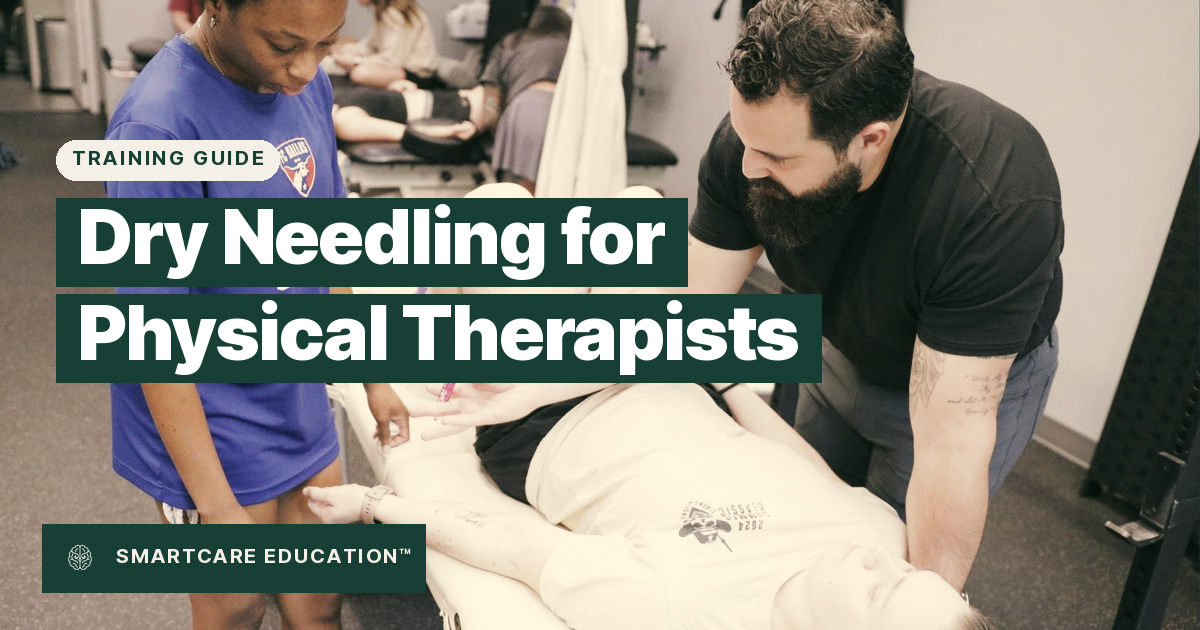
Dry Needling Training for Physical Therapists
Physical therapists across the United States can legally perform dry needling with appropriate training in many states, making it one of the most accessible manual therapy expansions available within the PT scope of practice. Requirements vary significantly by state, from specific training hour minimums to outright prohibition, so verifying your state practice act before pursuing any course is the essential first step.
For PTs who are eligible, dry needling training provides a structured pathway to add a clinically meaningful technique to an already strong manual therapy foundation. This guide covers state regulations, what quality training looks like, and how to evaluate your options.
Why physical therapists pursue dry needling
Physical therapists already work with the neuromuscular system through hands-on treatment, therapeutic exercise, and patient education. Dry needling fits naturally into that framework because it targets the same tissue dysfunction, specifically hyperirritable trigger points within taut muscle bands, that manual therapy addresses through compression and stretch.
There are several practical reasons PTs seek this skill:
- Myofascial pain is pervasive. A large portion of the musculoskeletal caseload involves active trigger points that contribute to local pain, referred pain patterns, and movement inhibition. Understanding what dry needling is and how it differs from acupuncture clarifies why it fits PT practice rather than competing with it.
- Complementary to exercise prescription. Needling a dysfunctional muscle prior to therapeutic exercise can improve motor recruitment and range of motion, potentially accelerating the response to corrective loading.
- Patient demand is growing. Patients increasingly arrive having researched dry needling and requesting it by name. PTs who are trained can meet that demand without referring out.
- Treatment efficiency. In high-volume outpatient settings, dry needling can address myofascial components of a presentation more efficiently than extended soft tissue mobilization, preserving hands-on time for joint work and exercise instruction.
The technique is not a replacement for the PT's core skill set. It is most effective when layered onto a thorough evaluation and integrated with exercise, manual therapy, and patient education.
State requirements for PT dry needling
This is the most consequential variable in the decision to pursue dry needling training. The regulatory landscape for PTs performing dry needling is not uniform, and the stakes of practicing outside your scope are significant.
The broad categories of state positions are:
- Explicitly permitted with training requirements. Some states have promulgated rules specifying minimum training hours, supervision requirements, or both. These states have the clearest pathway.
- Permitted under general scope language. Other states do not specifically address dry needling, but PT practice acts are broad enough that state PT associations and boards have issued guidance indicating it falls within scope with appropriate competency.
- Prohibited or contested. A smaller number of states have issued opinions or passed rules that prohibit PTs from performing dry needling, often due to lobbying from acupuncture licensing boards. Practicing in these states exposes a PT to license jeopardy regardless of training level.
The American Physical Therapy Association has published a position statement supporting dry needling as within the PT scope of practice when performed by a properly trained clinician. However, APTA's position does not override state law. For a working overview of where states stand, see our resource on dry needling laws by state, and verify current status directly with your state licensing board before enrolling in any course.
Some require documented mentored clinical hours following initial training.
What PT dry needling training covers
A well-designed dry needling course for physical therapists covers several interconnected domains:
Applied anatomy
Clinicians must develop confident three-dimensional knowledge of muscular anatomy, fascial planes, and regional neurovascular structures. This is not superficial memorization. Safe needling requires the practitioner to visualize depth, tissue trajectory, and nearby structures before inserting a needle. Training that skips rigorous anatomy review is not adequate preparation.
Trigger point theory and identification
The theoretical basis for dry needling centers on the integrated trigger point hypothesis and the neuromuscular mechanisms thought to underlie referred pain and local twitch responses. PTs learn to identify trigger points through palpation, correlate them with patient symptom patterns, and distinguish between primary and satellite involvement. For a detailed look at the clinical evidence, see our overview of whether dry needling works.
Needling technique
This includes needle handling, insertion angle, depth calibration, tissue engagement, eliciting the local twitch response, and withdrawal technique. Courses typically progress from superficial, low-risk muscle groups to deeper regions with higher anatomical complexity. Hands-on practice with feedback from experienced instructors is indispensable at this stage.
Safety and adverse event management
Contraindications, precautions, informed consent, sterile technique, sharps disposal, recognition of vasovagal responses, pneumothorax risk zones, and management of post-needling soreness are all required content. A course that treats safety as a brief module rather than an integrated thread throughout training is not meeting the standard.
Clinical integration for PT practice
Dry needling training designed for PTs should address how needling fits into a full PT plan of care: sequencing relative to manual therapy and exercise, documentation, goal-setting, and communication with patients about what to expect. A chiropractic-focused course may not emphasize PT-specific workflow considerations, which is worth evaluating when selecting a program.
Choosing a dry needling course as a PT
Not all courses are equivalent in rigor, instructor qualification, or clinical relevance. When evaluating options, consider the following:
- Instructor credentials and clinical experience. Instructors should have documented clinical experience with dry needling, not just academic training. Look for clinicians who actively practice the technique and can speak to real-world application.
- Curriculum depth. Review the syllabus critically. Does it cover anatomy in detail? Does it include cadaveric or advanced anatomy content for higher-risk regions? Is safety treated throughout the course or relegated to a single session?
- Evidence basis. The curriculum should reflect current literature on trigger point mechanisms, needling effects, and outcomes. Be cautious of courses that make unsupported mechanistic claims or cite heavily outdated sources.
- Hands-on hours. There is no substitute for supervised practice. A course that is predominantly lecture-based will not produce a clinician ready to needle safely. Confirm the ratio of didactic to hands-on content.
- State compliance. Confirm that the course meets your specific state's training requirements in terms of hours, content domains, and format. Do not assume that a well-marketed course automatically satisfies your state board's requirements.
- Post-course support. The learning curve continues after the course ends. Access to reference materials, case consultation, or a community of practice adds meaningful value for clinicians integrating a new technique.
For a broader comparison of available formats and a framework for evaluating programs, see our guide to dry needling certification.
Online and in-person training options
Dry needling training increasingly exists on a spectrum from fully in-person intensive formats to hybrid models that deliver foundational content online before hands-on skill days.
The theoretical components of a course, including anatomy review, trigger point science, needling mechanisms, and safety protocols, translate well to online delivery. A motivated clinician can build a strong foundation through self-directed online study, which is what online dry needling training is designed to accomplish.
Hands-on practice cannot be replicated online. No video, however detailed, substitutes for the tactile feedback of needle insertion, tissue engagement, and eliciting a local twitch response under supervision. Any pathway to clinical dry needling competency must include in-person, supervised practice hours. For those options, see our in-person dry needling training resources.
A note for physical therapists specifically: SmartCARE Education™, the leading dry needling education provider in the United States, holds PACE approval for chiropractic continuing education. Physical therapists interested in using this course for CE credit should check with their state PT licensing board regarding whether PACE-approved or equivalent courses satisfy their state's CE or training requirements. SmartCARE makes no representation that its courses fulfill PT CE requirements in any state.
Integrating dry needling into PT practice
The decision to add dry needling to a PT practice is not just a credentialing question; it requires a plan for clinical integration. A few principles apply regardless of setting:
Sequence thoughtfully
Dry needling is most effective when combined with movement and loading, not delivered in isolation. In most cases, needling should be followed by active exercise to reinforce the neuromuscular changes initiated by the technique. The sequence, needling first or exercise first, depends on the clinical presentation, but the two modalities should be planned together rather than treated as separate treatments.
Document precisely
Clear documentation of informed consent, the clinical rationale for needling, specific muscles treated, needle depth and technique, and patient response is both a medicolegal necessity and a tool for tracking outcomes. Developing a consistent documentation template before your first patient encounter will save significant time.
Set realistic patient expectations
Post-needling soreness lasting 24 to 48 hours is common and should be framed proactively, not reactively. Patients who understand what to expect are better equipped to distinguish normal tissue response from a sign that warrants follow-up.
Use it within a plan of care
Dry needling addresses one component of a musculoskeletal presentation. The PT's broader contribution, movement assessment, load management, exercise prescription, patient education, remains the foundation of care. Dry needling is most defensible, clinically and professionally, when it is integrated into a comprehensive plan rather than used as a standalone intervention.
Frequently Asked Questions
Can PTs do dry needling in my state?
It depends on your state. Many states permit PTs to perform dry needling; others prohibit it or have not issued clear guidance. The only reliable answer is your current state PT practice act and any supplemental guidance from your state licensing board. Our resource on dry needling laws by state provides a starting reference, but always verify directly with the board before practicing.
How many training hours do PTs need for dry needling?
Where states specify training hour requirements, the range is typically 24 to 54 hours, often with a required hands-on component. Some states do not specify a minimum and instead require documented competency. Others have no formal requirement at all because dry needling is addressed under general scope language. Check your specific state's rules rather than relying on a general figure.
Is dry needling within the scope of PT practice?
The American Physical Therapy Association's position is that dry needling is within the PT scope of practice when performed by a clinician with appropriate training and competency. Whether that position is reflected in your state law is a separate question. Scope is defined at the state level, not by professional association statements.
How is dry needling different from acupuncture?
Dry needling targets myofascial trigger points based on a Western musculoskeletal model. Acupuncture is rooted in Traditional Chinese Medicine and involves needling along meridian pathways based on an entirely different theoretical framework. Both use thin monofilament needles, which is the source of regulatory conflict in some states, but the clinical rationale, training content, and intended patient populations differ substantially. For a fuller explanation, see our post on what dry needling is.
Can I take an online dry needling course and meet my state's requirements?
Online coursework can satisfy the didactic portion of many states' training requirements, but very few, if any, states would accept an exclusively online course as complete preparation for clinical practice. Hands-on training under qualified supervision is required both for safety and, in most cases, for regulatory compliance. Confirm your state's specific requirements before enrolling in any course format.
Do I need to disclose dry needling training to my malpractice carrier?
Yes. Adding a new procedural technique to your practice scope is a material change that most malpractice carriers need to know about. Some carriers have specific riders or requirements for dry needling coverage. Contact your carrier before your first patient encounter to confirm your policy covers the technique.
A note before you enroll
Dry needling is a well-supported addition to the physical therapy toolkit in states where it is permitted. The path to adding it responsibly runs through two checkpoints: confirming that your state allows it and selecting training that is rigorous enough to produce genuine competency, not just a certificate.
SmartCARE Education™'s online dry needling program, the most comprehensive online dry needling certification available, is designed for clinicians who take that standard seriously. It is built on applied anatomy, current evidence, and the kind of clinical depth that prepares practitioners for real cases. Physical therapists and occupational therapists are welcome to use it as a foundational resource; CE credit applicability in your state is a question for your licensing board.
If you are evaluating your options, start with our overview of dry needling certification pathways for a structured comparison of what to look for in any program.
Recommended SmartCARE Education™ courses
- Online Certified Dry Needling Professional — complete the didactic portion on your schedule.
- In-person Certified Dry Needling Practitioner — hands-on training at the table.
- DN Video Library — technique videos you can review after a course.
Confirm CE acceptance with your licensing board before you enroll. PACE approval applies to chiropractors.
About SmartCARE Education™
SmartCARE Education™ is the leading provider of dry needling certification for healthcare professionals in the United States. Founded by Dr. Thomas Kauffman, DC, a practicing clinician who integrates dry needling daily in a high-volume sports medicine practice, SmartCARE offers the only comprehensive online dry needling certification (CDNP) available. The program is PACE approved for chiropractic continuing education and serves chiropractors, physical therapists, and occupational therapists nationwide. Explore the CDNP program.
