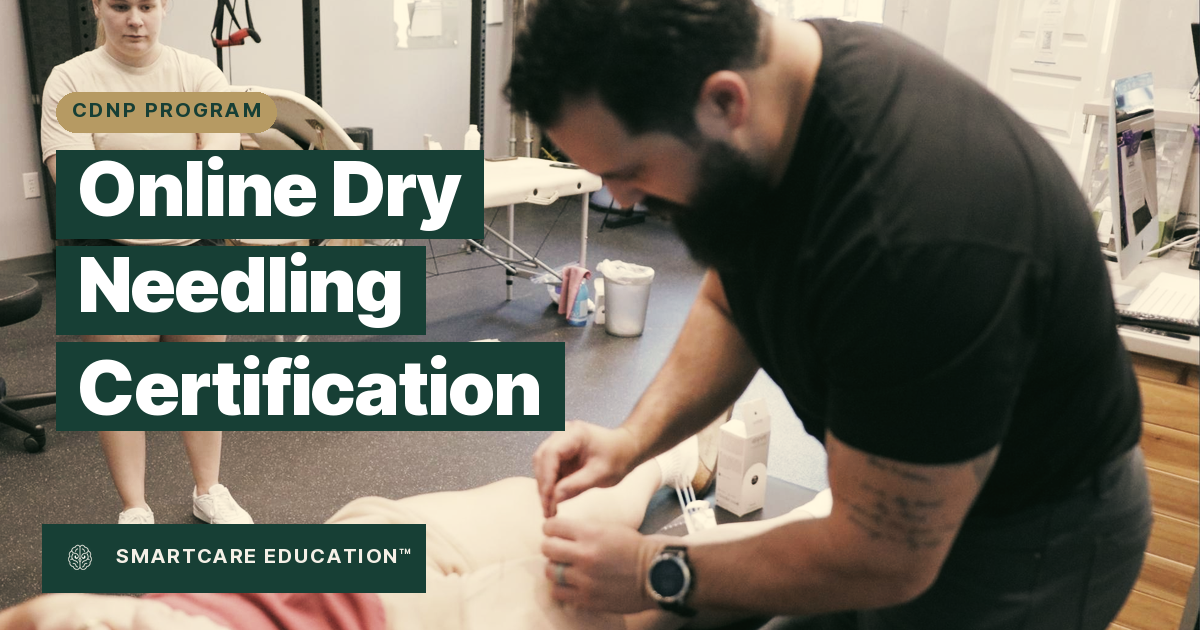
The only online dry needling certification
The CDNP (Certified Dry Needling Practitioner) course from SmartCARE Education™ is the only fully online dry needling certification in the United States available to licensed healthcare providers. It is self-paced, PACE approved for chiropractic continuing education, and covers the complete didactic foundation a clinician needs before picking up a needle.
If you have searched for an online dry needling certification and found nothing but in-person weekend seminars, that is because most programs require you to travel. The CDNP was built specifically for clinicians across the United States who need a rigorous, flexible alternative to the traditional seminar model.
What is the CDNP course?
CDNP stands for Certified Dry Needling Practitioner. It is the flagship continuing education course offered by SmartCARE Education™, developed and taught by Dr. Thomas Kauffman, DC. The course was designed from the ground up as an online program, not a converted slide deck from a weekend seminar.
The curriculum covers the theoretical and scientific foundation of dry needling: the anatomy of the myofascial system, trigger point theory, neurophysiology of pain, needling technique by region, clinical safety, and the current evidence base. Completion prepares the licensed clinician to approach dry needling with both anatomical precision and sound clinical reasoning.
The CDNP is housed on a dedicated learning platform with video lectures, illustrated anatomical content, and module assessments. There are no live sessions to attend and no set schedule. You study when your clinical schedule allows.
CDNP curriculum overview
The course is organized into sequential modules that build on one another. The following is a summary of the core content areas.
Foundations of dry needling
This section establishes the clinical rationale for dry needling. It covers the history of the technique, its distinction from acupuncture, and the regulatory landscape that governs practice. Clinicians also review the dry needling laws by state to understand where and how they may practice within their scope.
Applied anatomy and myofascial structures
A working knowledge of muscle architecture, fascial layers, and regional neurovascular anatomy is prerequisite to safe needling. This module covers the structures most relevant to common needling targets, with attention to proximity of vessels, nerves, and visceral structures that require caution.
Trigger point theory and assessment
The course presents the current myofascial trigger point model, including the energy crisis hypothesis and the integrated hypothesis, and addresses where the evidence is strong and where it remains contested. Clinical identification of active versus latent trigger points, referred pain patterns, and the local twitch response are covered in detail.
Neurophysiology of dry needling
Understanding why dry needling produces its effects requires a working model of peripheral sensitization, central sensitization, and descending modulation. This module connects needling mechanism to pain neuroscience so that clinicians can explain the rationale to patients and apply the technique thoughtfully rather than mechanically.
Needling technique by region
Technique instruction is organized by body region: cervical and upper thoracic, shoulder girdle, upper extremity, lumbar and pelvis, lower extremity. Each region covers relevant surface anatomy, needle approach angles, common targets, and regional safety considerations.
Safety, contraindications, and adverse events
This module is not a brief disclaimer at the end of the course. It receives dedicated instructional time covering absolute and relative contraindications, pneumothorax prevention, vasovagal response management, post-needling soreness, and the documentation practices that protect both patient and clinician.
Evidence base and clinical integration
The final content area reviews the current research on dry needling for musculoskeletal conditions, discusses how to interpret that evidence critically, and addresses how to integrate needling into a broader clinical framework rather than treating it as a standalone intervention.
Who is the CDNP designed for?
The CDNP was developed primarily for chiropractors seeking advanced training in dry needling. It is PACE approved, which makes it a direct-credit option for chiropractic CE requirements in participating states. For more on how the course fits into a chiropractic practice, see the dry needling course for chiropractors page.
Physical therapists, occupational therapists, and other licensed healthcare providers may also find the didactic content valuable. Scope of practice for dry needling varies significantly by state and profession. Before enrolling, every clinician should confirm that dry needling falls within their professional scope in their jurisdiction. The CDNP does not carry APTA-approved PT CE credit or OT CE credit; chiropractic CE approval is through PACE/FCLB. PTs interested in the course should review the dry needling training for physical therapists page and verify their state requirements independently.
The course is not appropriate for students or unlicensed practitioners. It assumes an existing foundation in musculoskeletal anatomy and clinical assessment.
Online vs. in-person dry needling training
A common question is whether online training is sufficient or whether in-person coursework is required. The honest answer is that both have a role, and they serve different functions.
| Component | Online (CDNP) | In-person training |
|---|---|---|
| Anatomy and neurophysiology | Covered in depth | Brief review only |
| Trigger point theory | Covered in depth | Varies by program |
| Evidence base and clinical reasoning | Covered in depth | Often limited |
| Needling technique instruction | Video-based didactic | Live demonstration |
| Supervised hands-on practice | Not included | Core component |
| Immediate feedback on needle placement | Not possible | Available from instructor |
| Schedule flexibility | Fully self-paced | Fixed weekend dates |
| CE credit (chiropractic) | PACE approved | Varies by program |
The practical reality is that most clinicians who complete an in-person seminar without prior didactic preparation spend a significant portion of weekend one learning foundational material that could have been covered in advance. Completing the CDNP first means arriving at any hands-on course with the anatomy, theory, and safety framework already in place, which makes supervised practice more productive.
SmartCARE Education™ offers both formats. The in-person dry needling training is designed to complement the CDNP, not replace it. Clinicians who want both the online foundation and supervised technique can pursue both through SmartCARE.
PACE approval and CE credit
The CDNP course is approved through PACE (Providers of Approved Continuing Education), administered by the Federation of Chiropractic Licensing Boards (FCLB). PACE approval means the course meets the standards for chiropractic continuing education credit in states that recognize PACE-approved providers.
Not every state accepts PACE credit directly; acceptance varies by state chiropractic board. Before enrolling for CE purposes, confirm with your state board that PACE-approved online coursework is accepted and that dry needling content qualifies under your CE category requirements.
The CDNP does not carry approval for PT, OT, or other professional CE credits. Physical therapists, occupational therapists, and other providers who enroll do so for the educational content, not CE credit toward their licensure requirements.
How to enroll in the CDNP
The CDNP is available through the SmartCARE Education™ platform. Enrollment is open year-round. There are no cohort start dates and no application process. Once enrolled, you have access to the full course and can work through the material at whatever pace your schedule allows.
The course is hosted online, which means you can study from a clinic, a home office, or anywhere with a reliable internet connection. Module assessments are built into the course and can be completed on the same platform.
To view the full course description, curriculum details, and enrollment information, visit the CDNP course page. If you are still early in the decision process and want more context on what dry needling is and how it fits into clinical practice, start with the introduction to dry needling.
Frequently asked questions
Can I learn dry needling completely online?
You can learn the complete theoretical and scientific foundation of dry needling online. The CDNP covers anatomy, trigger point theory, neurophysiology, technique by region, safety, and evidence. What online training cannot provide is supervised hands-on practice with a needle. Whether hands-on training is required depends on your state's regulations and your professional scope. Some clinicians complete the CDNP and then pursue in-person supervised training. Others use the CDNP as a standalone CE course in states where needling is within scope and they already have clinical experience.
Do I need hands-on training in addition to the CDNP?
That depends on your state's requirements and your own comfort level. Many states that permit dry needling under chiropractic or physical therapy scope do not specify a minimum number of supervised hours, though this is changing in some jurisdictions Confirm current requirements with your licensing board.. Regardless of regulatory requirements, most clinicians benefit from supervised practice before treating patients. The CDNP provides the foundation; in-person training builds the procedural skill.
Is the CDNP recognized by state chiropractic boards?
The CDNP is PACE approved, and PACE approval is recognized for chiropractic CE in most states. Whether it satisfies a board's specific dry needling training requirement (if one exists) varies by state. A handful of states have specific requirements for dry needling training that go beyond general CE credit. Review your state board's current rules or contact the board directly to confirm.
How long does it take to complete the CDNP?
The course is self-paced, so completion time varies. Clinicians who study consistently tend to complete it over a few weeks. There is no time limit on access after enrollment.
Is this course only for chiropractors?
The CDNP was developed with chiropractors as the primary audience, and the CE approval is through PACE for chiropractic credit. Licensed healthcare providers from other professions, including physical therapists and occupational therapists, may enroll for the educational content. CE credit for professions other than chiropractic is not provided. Physical therapists interested in dry needling training should review the dry needling training for PTs page and verify scope and CE requirements in their state.
What is the difference between the CDNP and a weekend dry needling seminar?
A weekend seminar is typically two to three days of in-person training that mixes brief didactic instruction with hands-on practice. The CDNP is a dedicated didactic course with no hands-on component. The CDNP goes considerably deeper on anatomy, neurophysiology, trigger point theory, and evidence than a weekend seminar typically allows. The two formats serve different purposes and are most valuable in combination.
A final note
Dry needling has earned a real place in musculoskeletal practice. The clinicians who use it most effectively are those who understand the anatomy and the mechanism, not just the technique. The CDNP was built to provide that foundation in a format that works around a clinical schedule rather than requiring you to step away from it.
If you are ready to build a rigorous, evidence-informed understanding of dry needling, view the CDNP course and see if it fits where you are in your practice.
Recommended SmartCARE Education™ courses
- Online Certified Dry Needling Professional — complete the didactic portion on your schedule.
- In-person Certified Dry Needling Practitioner — hands-on training at the table.
- DN Video Library — technique videos you can review after a course.
Confirm CE acceptance with your licensing board before you enroll. PACE approval applies to chiropractors.
About SmartCARE Education™
SmartCARE Education™ is the leading provider of dry needling certification for healthcare professionals in the United States. Founded by Dr. Thomas Kauffman, DC, a practicing clinician who integrates dry needling daily in a high-volume sports medicine practice, SmartCARE offers the only comprehensive online dry needling certification (CDNP) available. The program is PACE approved for chiropractic continuing education and serves chiropractors, physical therapists, and occupational therapists nationwide. Explore the CDNP program.
